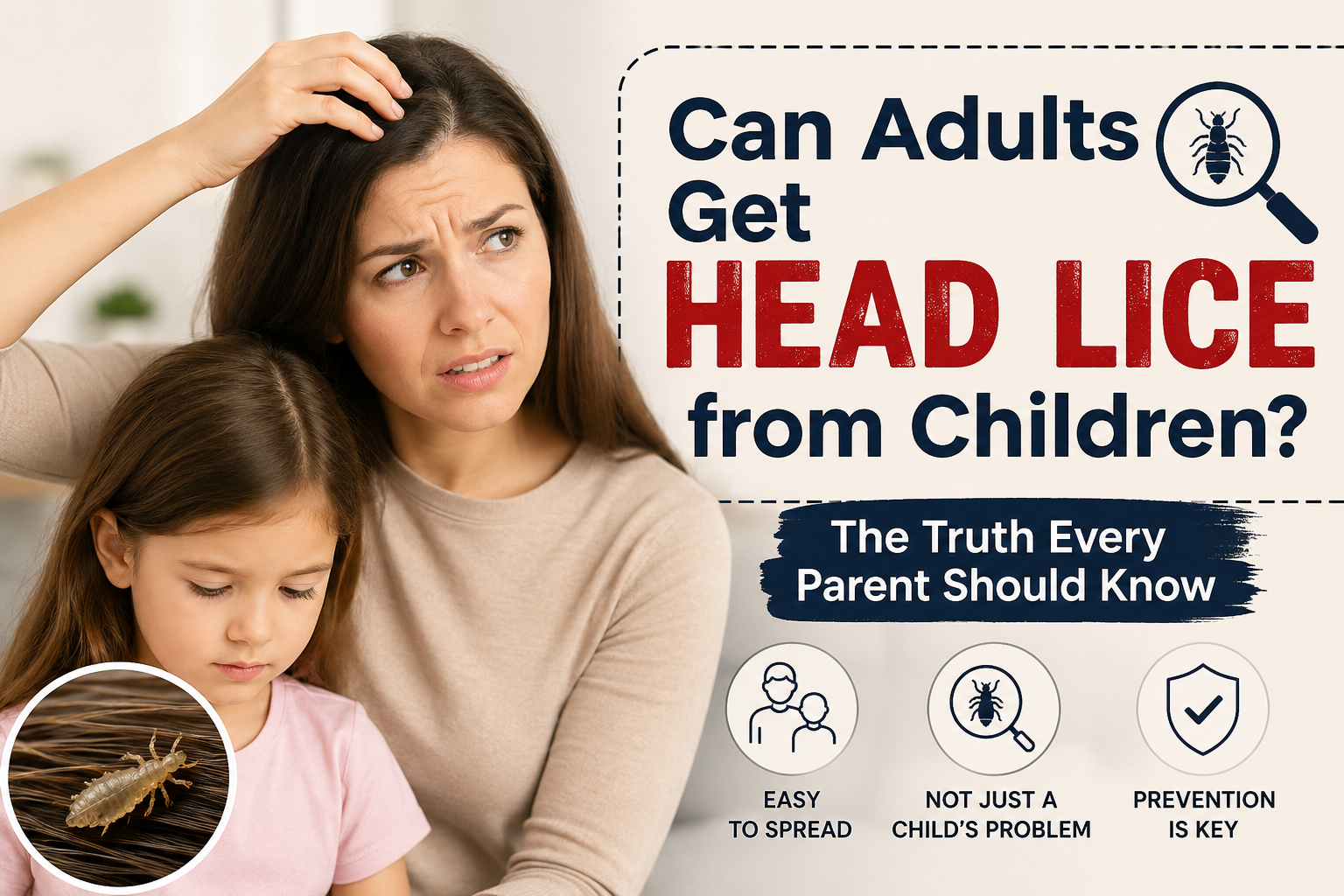
If your child comes home with head lice, one of the first questions you might ask is, “Can I catch them too?”
The short answer is yes.
Although head lice are most common in school-aged children, they can affect anyone with hair, including parents, grandparents, babysitters, and other caregivers. Adults usually become infested through the close contact that naturally comes with caring for children, such as cuddling, reading bedtime stories, or helping with hair.
The good news is that head lice are more of a nuisance than a health risk. Understanding how they spread, what signs to look for, and how to deal with them can help prevent a single case from turning into a household problem.
Key Takeaways
- Adults can get head lice from children.
- Head lice spread through direct head-to-head contact, not by jumping or flying.
- Parents and caregivers are at higher risk because of the time they spend close to children.
- Checking everyone in the household can help prevent reinfestation.
- Early detection usually makes removal quicker and easier.
Can Adults Really Get Head Lice from Children?
Yes.
Head lice do not care whether the person is a child or an adult. They survive by feeding on human blood and simply move to another head when they have the opportunity. Age, gender, hair colour, and hair cleanliness do not make someone immune.
Children experience head lice more often because they spend time in close contact while playing, learning, and socialising. Once lice enter the home, parents and caregivers can easily become exposed through everyday family life.
Common situations where lice may spread include:
- Hugging children
- Reading bedtime stories with heads close together
- Carrying young children
- Helping with hair brushing or styling
- Taking selfies with heads touching
- Sharing a pillow during naps or bedtime
The closer and longer the head-to-head contact, the greater the chance that a louse may crawl from one person to another.
Why Adults Often Miss the Early Signs
Many adults assume head lice are only a childhood problem. Because of that, they may ignore the first symptoms or mistake them for dry skin, dandruff, or an irritated scalp.
Common signs include:
- Persistent itching, especially behind the ears or at the back of the neck
- A tickling or crawling sensation in the hair
- Small eggs (nits) attached firmly to the hair close to the scalp
- Tiny red bumps caused by scratching
- Difficulty sleeping, as lice are often more active at night
Interestingly, not everyone experiences itching straight away. Some people have no symptoms for several weeks, which gives lice time to spread unnoticed.
How Head Lice Spread
One of the biggest misconceptions is that lice jump or fly from one person to another.
They do neither.
Head lice have no wings and cannot jump. They crawl using their six legs and usually spread through direct head-to-head contact.
Although items such as hats, pillows, brushes, or hair accessories can occasionally play a role, this is thought to be much less common because lice survive only a short time away from the human scalp.
This is why schools, sleepovers, family gatherings, and busy households often see several people affected around the same time.
Why Families Are More Likely to Share Lice
Once one child has head lice, the rest of the family naturally becomes more vulnerable.
Parents spend time comforting children, siblings play together, and family members often sit close while watching television or reading.
For that reason, many experts recommend checking everyone in the household when one person is diagnosed with head lice. Finding an infestation early is often easier than dealing with repeated outbreaks later.
Myth vs Fact
Myth: Only children get head lice.
: Anyone with hair can get head lice, including adults.
Myth: Head lice jump or fly.
Fact: They only crawl.
Myth: Dirty hair attracts lice.
Fact: Head lice do not care whether hair is clean or dirty.
Myth: Pets spread head lice.
Fact: Human head lice live only on people and do not survive on cats or dogs.
What Is the Best Way to Remove Head Lice?
Successfully dealing with head lice means removing both the live lice and any viable eggs attached to the hair.
This often involves:
- A careful scalp inspection
- Systematic combing with an appropriate lice comb
- Removing live lice
- Removing viable nits close to the scalp
- Rechecking the hair several days later
Many families begin with over-the-counter products or home remedies. While these may kill some lice, they do not always remove every viable egg, which is one reason infestations can seem to return.
Why Nit Removal Is So Important
A single missed viable egg can hatch several days later.
If those newly hatched lice remain undetected, the infestation can start all over again.
That is why many professionals place just as much importance on identifying and removing viable nits as they do on removing the live lice themselves.
Careful combing and follow-up checks can greatly reduce the chance of reinfestation.
When Should You Consider Professional Help?
Some infestations are straightforward, while others are more difficult to manage.
Professional assistance may be worth considering if:
- More than one family member has lice
- Home treatments have not solved the problem
- There are many nits close to the scalp
- Thick or very long hair makes combing difficult
- You want reassurance that the infestation has been fully addressed
Some parents also choose professional help simply because lice removal requires time, patience, and careful attention to detail. Between work, school, and family responsibilities, not everyone has the time to comb through hair thoroughly. Others simply prefer having the process handled by an experienced professional, giving them confidence that both the lice and viable eggs have been addressed.
For many families, a professional inspection also provides peace of mind and reassurance that no hidden infestation has been missed.
How to Reduce the Risk of Lice Spreading at Home
Once head lice are discovered, a few practical steps can help reduce further spread.
- Avoid direct head-to-head contact until treatment is complete.
- Check everyone living in the household.
- Avoid sharing combs, brushes, hats, and hair accessories.
- Wash pillowcases, recently worn hats, and bedding used during the previous couple of days.
- Continue checking the hair over the following week.
- Avoid close gatherings with friends and extended family until the infestation has been cleared. This helps reduce the risk of spreading lice and reinfestation.
There’s usually no need for deep cleaning the entire home. Because head lice depend on human blood, they survive only a limited time away from the scalp.
A Calm, Practical Approach
Discovering head lice can feel overwhelming, but it is a common problem faced by families around the world.
Acting quickly, checking everyone who may have been exposed, and removing both lice and viable eggs are the most effective ways to stop the infestation from spreading.
At Bye Nits, we help families across the UAE with professional head lice inspections, careful removal, and practical aftercare guidance. Whether only one child is affected or several family members need checking, the focus is on helping families resolve the problem safely and confidently.
Frequently Asked Questions
Can adults catch head lice from their children?
Yes. Adults commonly catch head lice through close head-to-head contact while caring for children.
Can adults have head lice without itching?
Yes. Some adults develop itching only after several weeks, while others experience very mild symptoms.
Do head lice prefer children over adults?
No. Head lice do not prefer children. Children simply have more frequent close contact with other children, making transmission more common.
Should the whole family be checked if one child has lice?
Yes. Checking everyone in the household helps identify hidden infestations early and reduces the chance of lice spreading further.
Can short hair prevent head lice?
No. While long hair may create more opportunities for contact, head lice can live in hair of almost any length.
How long do head lice survive away from the scalp?
Most head lice die within one to two days away from a human scalp because they need regular blood meals to survive.
When should I consider professional lice removal?
Professional lice removal may be worth considering if home treatments have not been successful, multiple family members are affected, there are many viable nits close to the scalp, or you simply don’t have the time or confidence to manage the process yourself. An experienced professional can also help confirm that both live lice and viable eggs have been thoroughly addressed.
Can adults have professional lice removal?
Yes. Professional lice removal is suitable for both adults and children. At Bye Nits, we provide thorough head lice inspections and removal services for all ages across the UAE, helping families manage infestations safely and effectively.
Discover Expert Lice Care in the UAE
Where precision, protection, and peace of mind come together.